After three active seasons and a number of special finds from the field, this summer the Tel Hadid team are excited to announce our 2021 Study Season!
In accordance with COVID-19 travel restrictions, the project has decided to wait until we can return to site with the entirety of our international team.
It is thanks to the collective efforts of our teams in 2018, 2019, and 2020 that we are now able to use this time to focus on the analyses of what we have already found, and the publication of what we already understand.
We appreciate that these changes to our field plans may disappoint, but we hope that the published results of our study season bring some comfort, and us all a little closer to the many tales of Hadid.
After three exceptional weeks, the Tel Hadid 2020 season as come to an end. Our staff and wonderful volunteers worked tirelessly to ensure the success of a dynamic and unusual summer excavation.
In Area CC fresh insights into the nature of our very own ‘stone monster’ Byzantine wine production complex were gleaned, and the expanse of this system of installations further understood.
Area CC at the end of Season 2020 (Photo by Omer Ze’evi-Berger)
In Area AAU we continued our patient work exposing Iron II remains. Our results from the season have increased the resolution through which we understand this exciting period of occupation.
Area AAU at the end of 2020 Season; note the rectangle curving at the central right hand side square (Photo by Omer Ze’evi-Berger)
The Survey team successfully executed numerous probes, effectively aiding in a broader and more comprehensive understanding of specific survey units, and of the Tel itself. The success of this season will allow for future areas of continued excavation in 2021.
Probe ST10/4 on the northern slope of the upper mound; a wide wall running along the slope (Photo by Omer Ze’evi-Berger)
We are profoundly grateful to all those who joined us this summer at Tel Hadid. It was a true joy to work in the familiarity of the soil, and we do not take that for granted.
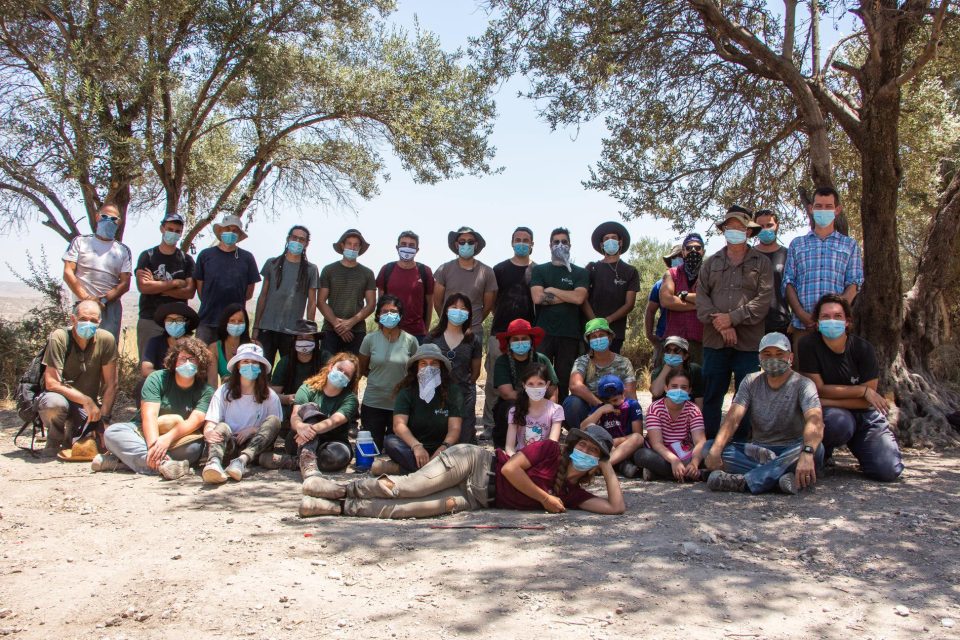
End of the season group photo (Photo by Noam Kodesh)
Keep an eye out for updates on our research, photos, and finds through Facebook and Instagram. For further information about our 2021 season please contact us.
In happening to land at Tel Hadid in my first experience volunteering on an archaeological dig, I was extraordinarily fortunate. For one thing, I happened to be part of a team that broke ground for a completely new excavation and was introduced to field archaeology with all the rich anticipation and learning opportunities of a new site. Another was the group of people I happened to be part of, which included experienced excavators as well as first-timers. A third way I in which I was fortunate is that I was able to do the entire three-week season. These all combined into the experience of a lifetime. If I may, I’d like to share it week by week.
Week 1
Meet the team! The Tel Hadid dig is a cooperative effort between the Sonia and Marco Nadler Institute of Archaeology at Tel Aviv University (TAU), and the Michael and Sara Moskau Institute of Archaeology at the New Orleans Baptist Theological Seminary (NOBTS). Depending on the day, we were a group of at least a dozen and up to two dozen, including students and professors of archaeology as well as team members. Most, but not all the team members were retirees, like myself. I was happily surrounded by people I would never have met in my every-day life—a grad student doing a thesis on the ancient olive oil industry, a naval ship designer, seminary professors, and of course archaeologists.
The first week was dive-in-and-swim through mental surf, including time zone upheaval, figuring out who was who, learning names, getting accustomed to using a pick-axe, discerning a vocabulary specific to archaeology, and adjusting to the schedule. The first week involved a little gritting of the teeth to get through, but there was also lots of laughter and the fun of getting to know each other. Quite a few of us had stories about delayed flights, lost luggage, and security snafus on the trip over, and conversation was always lively. The jokesters among us kept us going, and the pros from TAU were patient, generous in their oversight, diplomatic when we went astray, and never failed to remind us to drink water every 10 minutes!
Like other disciplines, archaeology has its own specialized language. We learned that “sectioning” doesn’t involve dividing up space, but actually means making the walls of a pit as perfectly vertical and smooth as possible, which makes variations in soil levels easy to spot. The funky hoe used to scoop loose dirt is called a turiyyah and is also used as the verb (as in, “turiyyah the dirt into a bucket…”). And, like elsewhere, the word “survey” refers to multiple activities. More about that later.
The excavation was located between a parking lot and a grove of olive trees, and since Tel Hadid is also a national park, we often had passersby and visitors in the form of bicyclists, dirt bikers, horseback riders, picnickers, and tour groups. Some stopped to chat; the shepherds kept their distance from the excavation, but we met herds of sheep and goats on the roadway in and out of the park. Not your typical US park experience!
Because we broke ground on a new site, we had to scrape off the vegetation before we could swing a pick-axe into the ground. Awkwardness ruled as we first tried using the turiyyah to scrape the ground and bumping elbows as we figured out how to stay inside the strings that marked the edges of the pits.
Our general day consisted of starting work at 6am and excavating until breakfast at 9:30am. After a quick picnic meal, we packed up the cooler, equipment, and personal stuff and moved to another part of the Tel to do some surveying. In this case, surveying meant that the group spread out and walked a defined section of the Tel, ideally covering the area uniformly to pick up the pottery bits lying on the surface. Each bit of pottery retrieved represented a data point that informed the overall historicity of the Tel. Each section of the Tel would later be analyzed with respect to the quantity of pottery shards retrieved, their age, relative plant ground cover (that prevented sampling), size of the section, number of people doing the sampling, and several other variables, which would ultimately guide future excavations. As a gesture of good will toward the public, we also collected dozens of bags of garbage.
While we were surveying by collecting pottery shards, two TAU students were surveying the Tel using GPS and mapping its many features, such as retaining walls, olive oil processing installations, and ancient cisterns and wells. Surveying continued (with a brief coffee break) until about 1pm, when the sun and heat became oppressive, and the day’s activities at the Tel were halted. The TAU staff returned to campus to resume other duties, and the rest of us took the pottery to the dig house for washing and cataloguing/registration (more about this in Week 2).
Week 1 began with bare ground marked with string and ended with multiple rectangular pits, all neatly surrounded with sandbags and dug to a depth significantly below the topsoil. When we quit for the weekend on Thursday afternoon, we happily looked forward to some rest as well as the tours of other archaeological sites for which Israel is so famous.
Week 2
In Israel, the week begins on Sunday, of course, and getting out of the van on the second Sunday morning of the dig (the pros from TAU were already hard at work, as usual) felt distinctly different from the mornings of the previous week. The difference, for me, was that after the first week’s experience and a weekend’s rest, I felt … competent! I don’t know if any of the others noticed, but we all automatically fell into the routine—unloading the van and placing the tools in minimal time, quickly gathering for safety reminders and the day’s assignments, and resuming excavation.
When we had quit work the previous Thursday, we were looking forward to the weekend and although we were proud of the first week’s progress, it wasn’t until resuming work on Sunday that we really appreciated what we had accomplished—turning a ‘blank’ bit of ground between a parking lot and a grove of olive trees into what was unmistakably a very cool archaeological site. Enthusiasm grew as the week went on and the buckets of pottery shards multiplied, and multiplied, and multiplied!
Area B during the first day of the second week
The second week of digging brought us to places where we frequently had to stop and consider what was happening (or had happened long ago) under our feet. The packed gravel of the parking lot gave way in some of the pits to a layer of nearly impossible-to-pick-axe rock. We learned more trade lingo: ‘three rocks make a wall’ and If something could be important, it’s a ‘feature’ until better defined.
My team-mates were well ahead of me in understanding how the process worked. But early in the second week, even I was starting to figure it out; how to see layers in a sectioned wall, what purpose a locus or multiple loci served in data collection, the difference between dirt that is an ancient floor and dirt that is just dirt.
Competence brings joy, and after the muddle of the first week, the second week was light-hearted in many ways. We easily spotted pottery bits as we dug, as well as some bits of bone, flint, and other types of ancient debris. We looked forward to the daily scan with the metal-detector, hoping for coins. We knew how to section. We were beginning to be field archaeologists!
But as I mentioned earlier, digging was only part of the experience. We continued to walk sections of the Tel and pick up pottery shards as part of the overall site survey. In the second week, we walked more remote parts of the Tel, and our TAU Professor pointed out the features being mapped by the two students and their GPS-equipped gadgets. Where I initially saw flora and fauna uniquely adapted to dry hot summers, varying elevation, and a unique soil type, I then began to see terrain with an archaeologist’s eyes.
Pottery survey by the team members
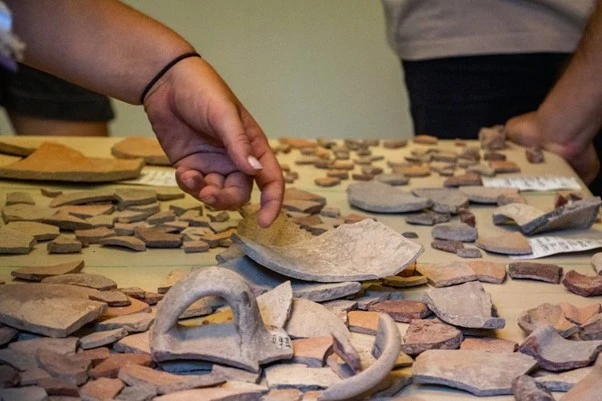
The second week we were also introduced to the phenomenon of pottery reading. The pottery bits we had collected in Week 1—both by digging and during surveying—had been placed in carefully labeled buckets. The previous week, we had gathered late afternoons on a patio outside the dig house and, accompanied by joking and laughter, washed the pottery shards one by one and put them in shallow boxes to dry. They were then catalogued by an experienced PD candidate who served as conservator/registrar. For the pottery readings, a table and chairs were set up outside the dig house, and a ceramics expert came to look at the shards. One by one, carefully labeled plastic bags of pottery bits were dumped on the table for perusal by the expert, who would select a few as significant for identifying the time period. The experts’ conclusions regarding that particular layer or locus were documented by the conservator, the shards cleared away, and the next bag spilled out for scrutiny.
Pottery reading led by the expedition senior staff
Following the pottery washings and readings, we often had the privilege of listening to a talk by one of the several experts from NOBTS, TAU, and Israeli institutions on some aspect of ancient near eastern, or ANE, history and archaeology.
By the end of the second week, we had reached fairly deep levels, and with each swing of the axe or scrape of the turiyyah, hoped an exciting find would appear. Our walking surveys had turned up a wealth of jar pieces, loom eights, and other ancient debris. We left the site on Thursday afternoon with a great sense of accomplishment, as well as looking forward to the weekend.
Week 3
Before I describe the third and last week of the dig season, I need to report how hard our dig leaders worked to make sure we had a rewarding time, not only as workers and learners, but also in the tours and other activities that were arranged for us. Between meeting their professional commitments as professors and archaeologists, and supporting and arranging activities for us volunteers, they got very little sleep in those three weeks. The NOBTS staff in particular made a staggering number of middle-of-the night runs to the airport, and that was only a fraction of the logistical issues they managed!
A special series of extra activities were planned for us during Week 3, including a tour of the campus and restoration laboratory at TAU, a lecture by Professor Oded Lipschits, Director of the Nadler Institute of Archaeology, and a fantastic dinner out at the Tel Aviv waterfront. We made another site visit, to the City of David in Jerusalem that included walking through Hezekiah’s Tunnel, and attended a special ceremony to mark the closing of the NOBTS excavation at Tel Gezer.
But back to archaeology. We began work on Sunday morning of Week 3 even more eager to find something spectacular. Several of us wanted above all to find a small tablet, or shard, or anything, with a cuneiform inscription! However, even as novices, we understood that the mundane data could ultimately be far more significant than a single find. Archaeology, like other fields of research, is clarified and understood in retrospect. It is by looking back at the data collected in previously excavated—and now destroyed—layers that the structures and patterns of human activity emerge.
I have to confess that we had become attached to the squares (actually 2×4 meter rectangles) we had been excavating! Who would have thought we could become protective, and even possessive, about a hole in the ground? And yet as the days passed, we all worried and asked the TAU staff what would happen to the dig site after the season ended and the area was at the mercy of the many visitors to the park. At the same time, even as we worried about leaving our excavation, in the back of our minds we were hearing the call of home and dreading good-byes.
Area B10 during the beginning of the third week
The TAU staff members, too, were feeling the coming cessation of the work. They had specific goals to attain that season, and they had many people dropping in to check on the excavation, from Israel’s National Nature and Parks Authority, the Israel Antiquities Authority, TAU, and others, throughout the three weeks. This first season at Tel Hadid could have an effect on their entire careers, and they especially wanted to finish the walking survey of the Tel. We all wanted to finish strong, to finish well, and we did in fact finish the walking site survey! It was a solid and very satisfactory ending to an extraordinary three weeks.
For those of us fortunate enough to go back for season two, we hope to return to the excavation and pick up again just where we left off. And we also hope to welcome many more team members and students to dig at Tel Hadid!
Looking Back
My three weeks of blogs described only one person’s experience at only one dig. But in looking back, there are some things I observed and learned that would, I think, apply to anyone considering joining a dig, whether for the next season at Tel Hadid or elsewhere. Here are a few thoughts to help you prepare for volunteering at a dig, with my hope that knowing about them in advance will allow you to get the most from your experience.
The Longer the better. I was fortunate to be able to stay the full three-week season. A shorter stay potentially results in a lesser learning experience.
Time-zone upheaval. Everyone knows to expect this. Prepare to set your attitude meter on ‘very enthusiastic’ (or at least ‘positive’) and endure until you feel better.
The early workday. Archaeology in Israel is governed by the sun. Work begins at or before sunrise, to avoid the mid-day heat.
A steep learning curve. As a complete novice and ignoramus of archaeological technique, I was often in a muddle about where and how deep to dig. Ask questions!
Tired muscles. The work is physically challenging. Besides the excitement of finding bits of pottery, expect to dig, collect, and haul off several times your own weight in dirt every day, while often working in cramped quarters, and possibly in the hot sun. Do so cheerfully.
Free of whining. You volunteered, and whining will just sour the experience for the rest of us.
Let the students shine. Archaeological digs are about researching the past, of course, but digs are also about teaching, particularly those students who will be the next generation of archaeologists. If you’re not a student, stand back and let them have the spotlight.
The incredible people around you. Some of us, especially us retirees, may know nothing of archaeology, but have decades of management, construction, communications, and other experience to contribute. The students may have classroom training, but are being introduced to field techniques. The dig supervisors are accomplished field archaeologists but may be new to instructing and supervising a bunch of clueless novices. Remember that we are all learning; the joy is in learning together.
Published in Hadashot Arkheologiyot, Excavations and Surveys in Israel 133 (2021)
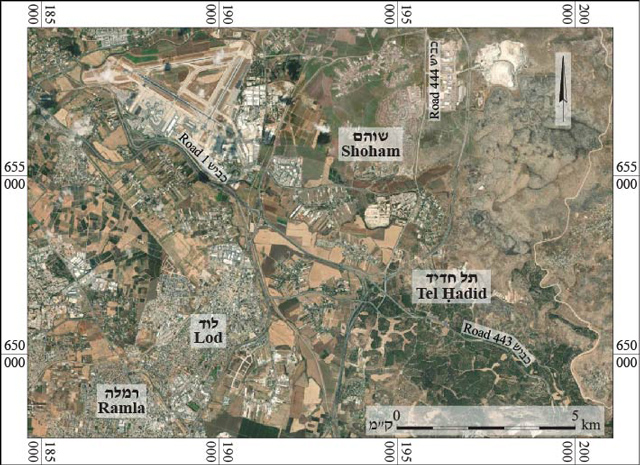
In June–July 2018 and June–July 2019, two excavation seasons were conducted at Tel Ḥadid (el-Ḥadita; License Nos. G-41/2018, S-848/2018, G-62/2019; map ref. 1950–60/6520–30; Fig. 1). The excavations, undertaken on behalf of Tel Aviv University and the Baptist Theological Seminary of New Orleans, were directed by I. Koch, D. Warner, E. Yannai, J. Parker and D. Cole, with the assistance of P. Warner (administration), A. Wrathall, O. Ze’evi-Berger, R. Lewis, G.D. Myers, S.L. Fredrickson, N. Ranzer and C. Roden (area supervision), C. Elberg, M. Allwood, A. Etya and N. Kodesh (area supervision assistance), O. Ze’evi-Berger and R. Avidov (archaeological survey), M. Johananoff (metal detection), M.L. Pruit (registration), O. Ze’evi-Berger (drafting), L. Freud, D. Sandhaus and I. Taxel (pottery), and S. Flint, O. Ze’evi-Berger, N. Kodesh, A. Etya and I. Koch (field and studio photography). Students from Tel Aviv University and the New Orleans Baptist Theological Seminary participated in the excavation, together with volunteers from Israel and abroad. The members of the archaeological team stayed at Neve Shalom guest house.
Figure 1: Location Map
Tel Ḥadid (45 dunams; c. 147 m above sea level) lies to the south of Naḥal Naṭuf, one of Naḥal Ayyalon’s tributaries. A wide flat terrace (c. 400 dunams) stretches westward and northward from the summit of the tell. Although rather limited, the previous archaeological research of Tel Ḥadid nevertheless shed light on the site’s history. A mosaic floor dating from the Byzantine period was unearthed to the southeast of the tell’s summit (Avi-Yonah 1972). Salvage excavations conducted on the tell in 1995–1997 (Brand 1996; 1998) prior to the construction of Highway 6 unearthed settlement remains, that range in date from the Intermediate Bronze Age up to the Arab village of el-Ḥadita, which was located on the tell until 1948, and Kibbutz Teḥiya, which occupied the site briefly in 1949–1950. These excavations recovered two clay tablets bearing cuneiform inscriptions dated to the seventh century BCE, which are probably associated with a community of deportees settled there under the administration of the Neo-Assyrian Empire (Na‘aman and Zadok 2000). Additional salvage excavations on the tell uncovered remains from the Late Bronze Age and the Iron Age II, as well as the Roman and Byzantine periods (Yannai 2012; Nagorsky and Yannai 2016; Torgë 2016).
During the two current excavation seasons, a thorough survey was conducted of the tell, and five excavation areas were opened (AAL, AAU, B10, CC, T1; Fig. 2). The excavation yielded architectural remains and pottery from Iron Age II, the late Hellenistic and the Byzantine periods, as well as pottery from the Late Bronze Age, and the Persian, Mamluk Ottoman and the British Mandate periods. The main objectives of the field work in the 2018–2019 seasons were (1) to document the buildings, rock-hewn features and finds in the area of the tell; (2) to unearth further Iron Age II remains on the tell’s northeastern slope, near the Highway 6 tunnel (Areas A and B of the 1995–1997 salvage excavations); (3) to examine a series of walls surveyed on the tell’s upper northwestern, western and southeastern slopes; and (4) to uncover the components of a large wine-production complex in the center of the low terrace near the summit of the tell.
Figure 2: Map of Excavation Areas
The Survey. A thorough survey of the tell was conducted during the 2018 filed season. It included the collection of surface finds, mostly potsherds, and a detailed documentation of some of the site’s buildings and rock-cuttings, including quarries, agricultural installations and cisterns. The tell was divided into 25 survey units, which comprised 54 sub-units based on topography, vegetation, accessibility and discernible features. Surface finds were collected in 34 sub-units, and buildings and rock-cuttings were fully documented in two additional units. A File Maker-based documentation system was used with the Maprika application, which allows surveyors to track and report their progress and mark points of particular interest. In addition, the GPS-RTK Leica GG03 system was used to establish the exact locations and landmarks. All the finds from the survey were washed and counted; diagnostic potsherds were dated and preserved for future publication. Preliminary data attest to an occupation sequence in all the periods in the survey units. A large number of Iron Age II potsherds were evident on the low terrace, while numerous Hellenistic potsherds were documented on the summit of the tell. The buildings and rock-cuttings that were surveyed were all allocated an identifying number, measured, drawn and recorded on a 3D model using photogrammetric software (Agisoft). To date, 182 walls and rock-cuttings have been recorded in 12 sub-units.
Area AAL (Fig. 3). The area stretches across the northeastern slope of the tell’s low terrace, to the east of the Highway 6 tunnel’s northern opening. Four half-squares were excavated yielding modern finds—orange marking tape, plastic bottles and coins from the 1980s onwards—along with a mixture of pottery, building blocks, glass fragments, flints, tesserae, bones and coins. Debris from the salvage excavation areas was apparently dumped here during the construction of Highway 6. A soil accumulation on the bedrock in one excavation square contained potsherds from Iron Age IIC to the Hellenistic period.
Figure 3: Area AAL at the end of Season 2019
Area AAU (Fig. 4) was excavated near Area AAL. Two squares and three half-squares were opened, both because the survey data showed a high concentration of Iron Age II pottery, and because of the area’s proximity to the salvage excavation, especially Area A5 where architectural remains from this period were unearthed. Piles of modern earth and debris that were found near the area are probably related to the salvage excavations and the construction of Highway 6. Surface finds were retrieved from the late Hellenistic, Roman, Byzantine, Mamluk and Ottoman periods, as well as from the British Mandate era. The excavation uncovered layers of tamped earth mixed with late Hellenistic potsherds on top of Iron Age IIC pottery, including complete vessels.
Figure 4: Area AAU
Area B10 was opened near Area B of the 1995–1997 salvage excavations with the aim of unearthing additional Iron Age II remains. Accumulation layers found in four half-squares contained pottery from the Iron Age, Persian, Hellenistic, and Byzantine periods. The area had been disturbed by the planting of an olive grove, part of which is still visible to its north.
Area CC (Fig. 5). The area extends across the center of the low terrace, northwest of the tell’s summit. Preliminary inspections of the tell identified a large rock-hewn complex almost completely buried under mounds of earth, pottery and modern debris. It was assumed to be a Byzantine wine-production complex. A community excavation was conducted in this area in collaboration with Modi‘in Regional Council, with the participation of third- and fourth-graders from schools in Ben-Shemen and Modi‘im-Nehalim and families from the nearby communities. An excavation in the center of a round central space in the complex—possibly the winepress’s treading floor—unearthed a square stone screw base. A deep collecting vat and a mosaic-paved settling basin, both circular, were partially uncovered to the east of the screw base. Hewn channels ran between the central space and the settling basin, and between the settling pit and the collecting vat. The extent of the complex was probably larger than was previously assumed, as additional circular installations were identified around it. The plaster coating on various parts of the complex contained Byzantine potsherds, dating it to this period.
Figure 5: Area CC at the end of Season 2019
Area T1 (Fig. 6). During preliminary exploration of the site, several walls were documented on the upper northwestern, western, and southwestern slopes of the tell. The sub-units in this area yielded Iron Age II and Hellenistic pottery, as well as a few potsherds from the Byzantine and Ottoman periods. Following the survey, two excavation squares were opened in the northwestern part of the summit, in a place that had been damaged by all-terrain vehicles (ATVs). Two wide walls built of two rows of fieldstones formed the corner of a building. Late Hellenistic pottery was found in the space between the two walls. The building may have been constructed at the same time as a building lying to its west. The latter, which was only partially examined, includes a stepped wall built of fieldstones and ashlars.
The Tel Hadid Archaeological Project is happy to announce the dates of the 2025 season!
We are excited to be returning to Tel Hadid for another field season! Following a year-long hiatus due to the war, we’re resuming our archaeological investigations into the rich history of this site. Our excavations will continue to explore the remains of the 7th century BCE deportees, the impressive Hasmonean-period fortifications, and the later al-Haditha village. We invite you to join us in uncovering the past! Learn more and register on our “Registration & Contact” page or by emailing Hadid.excavations@gmail.com.